Wednesday, 7 December 2011

St Cyrils Rehabilitation Unit - Challenging Behaviour Service

Today we (Angela Carter, Elizabeth Hardy, Gareth Pennell and I) attended the Open Day of St Cyrils Rehabilitation Unit.  This unit is owned by St George Healthcare Group and is on the site of the Countess of Chester Hospital.  As brain injury case managers we were all interested to see what this unit could offer clients.

The morning began with the official opening ceremony performed by Mr David Thompson MBE, who is the currenty Deputy Lieutenant of Cheshire.  This was followed by an introduction and welcome by Dr Czarina Kirk, the Consultant Psychiatrist for the unit. 
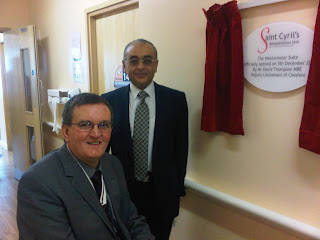

The particular part of the unit that was opened today specialises in treating and rehabilitating people who have experienced a brain injury and are displaying challenging behaviour.  It is the first of its kind to specialise in this field in the North West.  The unit intends to take referrals from around the country including Northern Ireland.  This particular part of St Cyril's has seven beds available but the unit as a whole has twenty beds.  All bedrooms are ensuite and are equipped with the latest technology.  The Unit also benefits from spacious recreational areas, visiting rooms, cafes, two transitional bungalows, physiotherapy gym, hydrotherapy pool, occupational therapy suites which include a sensory integration room, rehabilitation kitchen, sensory garden, education and IT classroom.

Dr Vanessa Owen gave a presentation entitled "The Interdisciplinary Team and Complex Brain Injury Cases'.  She explained that, although there are units specialising in brain injury rehabilitation around the country, not many can cope with challenging behaviour.  She explained that the unit intend to get all interested parties involved with the rehabilitation process.  This not only includes the interdisciplinary medical, nursing and therapy team but also the family and external services who are likely to be involved with the client in the future.  These agencies, in particular, are encouraged to engage with the unit and the service user right at the beginning of the rehabilitation process.  Good communication and working together towards a common person centred goal is at the heart of good rehabilitation and something we encourage as brain injury case managers.

I think we can all agree that this is a common sense approach which, apart from achieving effective outcomes for service users, also helps break down barriers between different disciplines. 

The final presentation was given by Dr George El-Nimr, Consultant Neuropsychiatrist on Huntingtons Disease.  This was an excellent talk explaining eloquently how, in the past, this disease has been classified as primarily a degenerative neurophysical disorder with some cognitive and psychiatric symptoms but that it should really be seen as primarily a degenerative neuropsychiatric and cognitive disorder with physical symptoms in the form of difficulty initiating movement, muscle rigidity and un-coordinated movements.  He explained in detail the cause of this genetic disorder and how children as young as two years old can be found to display symptoms.  He explained that in the future professionals need to communicate better with each other and work together to provide better care, treatment and rehabilitation for these service users. 

Lots of interesting information given with time for questions at the end followed by lunch.  Altogether a good half day with information gained about the unit to take forward for us working in brain injury case management and clinical negligence report writing.

Helen Sheard, Consultant Occupational Therapist

Tuesday, 15 November 2011

Hospital Discharge, Risk Assessment & Reablement


As a provider of manual handling risk assessment services and reablement training to local authorities Personal Care Consultants has seen a steady increase in demand for our services since we started in 2002.  

Manual handling risk assessment referrals often include providing assessment visits to those people who are in receipt of a formal package of home care, those people who live in residential care setting and to facilitate patients who are being discharged from hospital. 
The primary benefits of the manual handling risk assessment service to local authorities include extremely efficient response times.  We have a large team of experienced risk assessors whose professions include Occupational Therapy and Nursing.  Our team will respond to the initial request for an assessment within 24 hour of its receipt and strive to arrange an initial assessment visit within 48 hours.  Following an initial detailed and thorough assessment of the client medical history, functional ability and environmental considerations, recommendation will be made to the client and their carers. Following negotiation and agreement, an urgent equipment request will be made to the appropriate jointly funded Community Equipment Service for immediate delivery.  As Personal Care Consultants generally deal with the highest priority and most complex cases, urgent equipment deliveries are made.  A follow up visit is then usually arranged to review the recommended equipment, ensuring it can be used safely and meets the client’s and carer’s needs.  Importantly, time is taken to ensure that any recommended equipment reduces the potential risks of injury to the lowest practicable level in line with current health and safety legislation.

In order to plan for an anticipated increase in hospital admissions this winter, NHS hospital trusts across the nation will be drawing up winter contingency plans in order to cope with the demands they undoubtedly face. In recent years flu epidemics, extreme adverse and inclement weather and a massively increasing dependant population have seen admissions into our acute hospitals during winter time rocket.  So, how can this situation be better dealt with this year?  Surely we must have learnt some lessons from previous years?

One solution may include the increased use of our manual handling risk assessment service to both prevent hospital discharges and to facilitate early discharges. 

Further solutions also must include the better use of intermediate care facilities and services to reduce the high numbers of inappropriate admissions, delayed hospital discharges and facilitating early discharges from hospital.  In most cases, providing clients with a period of reablement to become as independent as possible in their own home, benefits everybody concerned.  Not only does this reduce the pressure on the NHS but in most cases individual clients would prefer to be cared for in their own home and maintain or regain as must independence as possible. So with this in mind let’s get more of our health and social care staff trained in reablement skills and make better use of their experience and expertise.  

If we don’t make changes to the provision of our health and social care this winter, undoubtedly the most vulnerable members of our community will suffer unnecessary and prolonged hospital admissions.  If you take a minute to think about this, where would you or your family rather receive care if it was required?

Visit our Risk Assessment and Health and Social Care training pages for more information on the service we provide. For further information please complete our online enquiry form or telephone 01244 390677.

Friday, 30 September 2011

The BIRT (Brain Injury Rehabilitation Trust) Conference 2011


Liz Hardy and I attended this year's two day conference in Bristol at the Marriot Hotel. This year's theme was very much focused on emotional brain damage and how this can affect relationships and social interaction.  All the plenary sessions were on the first day (Wednesday, 21 September) and very much focused on this emotional theme.

The first session was given by Professor Roger Wood from Swansea University.  His talk was entitled "From neuropathology to psychopathology: understanding neurobehaviour disability as a focus for post acute rehabilitation".   He talked about types of brain injury and stated that whatever the site of the injury the principal location of damage is the frontal structures.  He described the four areas of the frontal lobe as having specific roles but that there is a lot of overlap between these areas.  Damage in these areas are known as Frontal Lobe Syndrome and Dysexecutive function.  He went on to talk about temper control and social cognition and how better knowledge of dysfunction in these areas can lead to better rehabilitation approaches.  A really riveting talk and thoroughly enjoyable as well as factual and practical.

The second session was entitled "Ambiguous Loss: how uncertainty impedes caregivers' and patients' emotional recovery" .  This talk was given by Professior Jeff Kreutzer, Director of Neuropsychology and Rehabilitation Psychology, Virginia Commonwealth University.  Professor Jeff Kreutzer described Ambiguous Loss as the state family members find themselves in when the person who has sustained the head injury is phyiscally present but the neurobehavioural changes that have occurred make it unsettling.  They commonly state that they are "married but do not have a husband" or feel as if they are "married to a stranger".  He sited various books written by head injury family members explaining their journey through managing the brain injured person describing patterns of reaction and adjustment over time.  He stressed the importance of professionals working with brain injured clients in facilitating the recognition of ambiguity,  to educate the patient and caregiver about the general course of recovery and provide emotional support.  Again good factual information with practical strategies to help patients adjust.

Dr Charles Bombardier from the University of Washington School of Medicine in Seattle presented a talk entitled Depression after Traumatic brain injury.  He talked about the cause of depression after TBI being uncertain and that it is likely to multifactorial.  He stated how post TBI depression can be linked to a variety of negative outcomes, including greater cognitive impairment, poorer rehabilitation outcomes, increased functional disability, reduced participation, poorer recovery, elevated post concussive symptoms, reduced employment potential, increased care-giver burden, reduced life satisfaction and poorer health related quality of life.  He went on to state the need for more research and clinical trials to improve the treatment for these patients.

Professor Huw Williams, Associate Professor from of Clinical Neuropsychology at the University of Wales gave a comprehensive presentation on "Neurorehabilitation and emotion: challenges to fitting into a social world" He talked about the importance of social group memberships and outcomes to be achieved through neuro-rehabilitation - to be in work, to have a range of friends, to have a family life.

The final talk of the day was given by Professor George Prigatano from Barrow Neurological Institute, Phoenix, Arizona on Neuropsychological rehabilitation of adults and children with a history of traumatic brain injury: challanges and opportunities.  In his talk he spelt out the challenges that face professionals with regards to rehabilitation of this group of people, the need for further research in treatment approaches and its effectiveness both in patient outcomes and demonstrating the long term cost effectiveness of such treatments.
On Thursday there were various workshops throughout the day.  I attended How does dementia affect music processing?,  Practical Approaches to effective family intervention and Development of the GUIDE prompting system.  I was particularly interested in the last talk as this system uses technology to verbally prompt people through the various stages of everyday activities to enable people with cognitive problems to engage in these activities.  It is particularly targeted at patients with sequencing problems. The development of this system is based on research and is in the early stages of development using computer technology with a voice recognition programme.  It will be interesting to see how well it works once the system is in place.

The two day conference provided an opportunity for Liz and I to meet other professional working in the field of brain injury and we had an enjoyable evening on Wednseday at the dinner sponsored by Barclays bank.

Helen E Sheard
Consultant Occupational Therapist

Contact us now on 01244 390677 or training@thecareplan.com for information regarding our Acquired Brain Injury training course. 

Thursday, 15 September 2011

Is a lack of adequate training putting care home residents at risk?


Following the closure of Winterbourne View and Rose Villa Care Home in Bristol, the nursingtimes.net reported on 17 August 2011 that a third care home run by Castlebeck is to close. The Arden Vale Care home in Solihull is reportedly being closed ahead of legal action by the Care Quality commission (CQC).

The CQC investigated Castlebeck’s other homes following abuse uncovered by BBC Panorama at Winterbourne View in Bristol. The CQC found “serious concerns” at four of the homes.
It is also understood that on the 28 July 2011 the Nursing Midwifery Council (NMC), the governing body for nursing and midwifery in the UK, launched an investigation into the conduct of nurses employed at a number of care homes owned by the Castlebeck care home group.

NMC chief executive Professor Dickon Weir-Hughes said: “Some registered nurses appear to have forgotten the most basic elements of their professional code of conduct”.

The investigation follows publication of the CQC’s report into the quality of care at 23 of the 24 care homes in the Castlebeck group, it concluded that 11 out of the 23 did not comply with CQC standards.

The CQC report identified a number of serious concerns including poor training, inadequate management of safeguarding incidents and poor care planning. 
The CQC has also issued a formal warning to Carmand Limited stating that it must make urgent improvements to standards of care at two of its nursing homes. Inspectors found that people’s care needs were not monitored on a regular basis and that the care plans that were in place did not reflect the current needs of the people who used the service. 
The owners of a care home at Congresbury in North Somerset have been told by the CQC that they must take action to ensure that people are protected from unsafe or inappropriate care.
The Care Quality Commission (CQC) recently inspected St Catherine’s Care Home, Horwich.  The CQC report highlights the regulator’s major concerns including the following:
  • There were gaps in promoting the privacy and dignity of people who lived at St Catherine's Care Home.
  • People's health and wellbeing was at risk because risks they faced in relation to malnutrition and dehydration were not properly assessed or managed.
  • People's health and wellbeing were at risk because medication was not being managed safely.
  • People did not have their personal and confidential information appropriately managed. There were significant gaps in the quality and security of personal information.

The cases highlighted above identify poor practice in record keeping, communication, care planning and in ensuring the nutritional needs of residents is met. Staffing levels, obviously, are an important factor in the delivery of quality care. 

The current economic climate has ensured all businesses are reluctant to spend money where there is no immediate and concrete return. The first expenditure and resources to be cut are training and training budgets.

It is clear, as identified by CQC in their investigations, that quality training is required across the care sector, to ensure that residents receive suitable, sufficient care in a positive, healthy and safe environment.

Personal Care Consultants can offer a tailored training package to care home managers and their staff to refresh and improve skill levels and knowledge in all or any of the following areas:-
  • Health and Nutrition
  • Catheter Care
  • Infection Control
  • Administration of Medication  
  • Record Keeping & Reporting
  • Risk Assessment
  • Pressure Sore Prevention and Treatment
  • Outcome Focussed Care Planning
  • Principles of Care
  • Manual Handling of People
  • Dementia Awareness
  • Diabetes Awareness
For more information please visit our Training pages or e-mail training@thecareplan.com or call us on 01244 390677 for an informal discussion of your requirements.

Thursday, 11 August 2011

Training Successes

Training and Development Framework Success!

Personal Care Consultants have recently been awarded places on two major Training and Development framework agreements.  The first was the North Wales Procurement Partnership framework for social care and health and safety lots.  The second was the Wiltshire Council Learning and Development Framework.  We look forward to working with all parties in the near future!

Changes to Part 35 Civil Procedure Rules

BRIEF SUMMARY OF CHANGES TO PART 35 CIVIL PROCEDURE RULES

I recently attended a half day training course organised by N-Able Services Ltd, Bromborough.  They commissioned Bond Solon (a legal training consultancy) to carry out the training.

The aim of the course was to update all professionals carrying out Expert Witness work on the significant changes which came into force on 1 October 2009 with regards to Part 35 and consequential Practice Directions of the Civil Procedure Rules and the 2005 Protocol for the Instruction of Experts.
In brief the changes are as follows:
  • The definition of an Expert has been clarified
  • Guidance is provided on the appointment of Single Joint Experts
  • There is a new statement of Truth and corresponding declaration of awareness of the rules
  • Directions are given on written questions to experts.
Details of the above can be found on the following website:
www.ministryofjustice.co.uk

The trainer gave some invaluable guidance which I would like to impart to you.
Firstly, with regards to “awareness of the rules”, the new Statement of Truth has to include a statement making reference to the fact that we are aware of the requirements of Part 35.  The trainer made it clear that it is likely, should we have to give evidence in court, that we will be asked if we are aware of the rules.  So boning up on the rules is advisable!!

He also stated that it is likely that we may be asked how many reports we have completed – again it is a good idea to be aware of this.

We also have to give, in the body of the report, the range of opinions (if there is a range), not just our own opinion.

It is also likely, in the future, that both experts will be in court at once rather than at different times – he called it “hot tubbing”!!

In the case of the joint expert, the courts may decide who will be the joint expert if both sides cannot agree.    If, as a joint expert, we receive different instructions from each side, we, as experts, have the right to make application to the courts to define the rules.  The trainer suggested that the best way forward (if we find ourselves in this situation) is to first write to both solicitors explaining that the instructions are contradictory and, if they cannot sort it out, then we will have to apply to the courts for guidance.  It is likely that this letter will get results so avoiding application to the courts!

The agenda for the joint meeting between experts (resulting in the joint statement) will be set by the solicitor.  We can be assertive with regards to this and talk to the solicitor if we are unhappy about their instructions.
The trainer also suggested that a good way forward now for reports is to put our conclusions at the beginning of the report (either as well as or instead of at the end).  As far as OT reports are concerned, this is likely to be the equipment and care tables that we usually put in the Appendix.

Written questions to experts must be put only once and within twenty eight days of service of the expert’s report and must be for the purpose only of clarification of the report unless in any case the court gives permission or the other party agrees.

Finally, we must always remember that our overriding duty is to the courts – not the commissioning solicitor!

Helen E Sheard
Consultant Occupational Therapist

Personalisation Agenda and Outcome Focused Care

Personalisation Agenda and Outcome Focused Care

We are increasingly being approached to profile training courses to meet the changing culture involved in the personalisation agenda.  So what is the Personalisation Agenda and what is needed to facilitate its implementation on the ground?

Government policy is increasingly emphasising the importance of service users having choice and control in health and social care.  The policy, particularly in social care, is known as “personalisation”. The Department of Health explains this as a move away from the traditional welfare state to a consumer-type model of service provision.

Below is a precis of the Department of Health’s vision around the personalisation agenda first published in 2008.  Full details are available on their website www.dh.gov.uk.


Department of Health – Working To Make It Happen – The Vision – June 2008
“..We want everyone receiving social care support, regardless of their level of need, whether they live in the community or in residential accommodation or whether their support is funded by themselves or by the State, to have choice and control over how their own support is designed and delivered..”
“The delivery of this vision places personalisation at the centre and binds together all the key players. It will mean the workforce assuming a more proactive and enabling role in how they respond to peoples’ needs and preferences.

“We need to develop and build on the skills people working in adult social care have, to equip them with the confidence and capability to meet new challenges and changes”
Putting people first will involve the following:
  • Person centred planning and self directed support
  • Personal budgets for everyone eligible for publicly funded adult social care support
  • Direct payments utilised by increasing numbers of people
  • Family members and carers to be treated as experts and care partners (other than in circumstances where their views and aspirations are at odds with the person using the service).
Our company recently provided training for a metropolitan borough council who have contracted out all their social care support to private agencies. The training we provided was for senior staff within these agencies giving them the knowledge to provide information around the personalisation agenda, outcome focused care and training in enablement and rehabilitation for their own staff.

This training is one way for commissioners to ensure that the message and change in culture involved with personalisation reaches all partners involved in provision.

How are you getting the key messages across?