Showing posts with label Brain Injury Case Management. Show all posts

Wednesday, 7 December 2011

St Cyrils Rehabilitation Unit - Challenging Behaviour Service

Today we (Angela Carter, Elizabeth Hardy, Gareth Pennell and I) attended the Open Day of St Cyrils Rehabilitation Unit.  This unit is owned by St George Healthcare Group and is on the site of the Countess of Chester Hospital.  As brain injury case managers we were all interested to see what this unit could offer clients.

The morning began with the official opening ceremony performed by Mr David Thompson MBE, who is the currenty Deputy Lieutenant of Cheshire.  This was followed by an introduction and welcome by Dr Czarina Kirk, the Consultant Psychiatrist for the unit. 
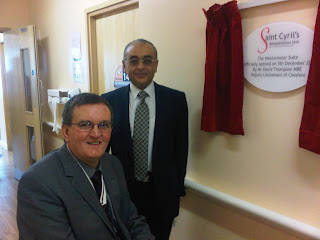

The particular part of the unit that was opened today specialises in treating and rehabilitating people who have experienced a brain injury and are displaying challenging behaviour.  It is the first of its kind to specialise in this field in the North West.  The unit intends to take referrals from around the country including Northern Ireland.  This particular part of St Cyril's has seven beds available but the unit as a whole has twenty beds.  All bedrooms are ensuite and are equipped with the latest technology.  The Unit also benefits from spacious recreational areas, visiting rooms, cafes, two transitional bungalows, physiotherapy gym, hydrotherapy pool, occupational therapy suites which include a sensory integration room, rehabilitation kitchen, sensory garden, education and IT classroom.

Dr Vanessa Owen gave a presentation entitled "The Interdisciplinary Team and Complex Brain Injury Cases'.  She explained that, although there are units specialising in brain injury rehabilitation around the country, not many can cope with challenging behaviour.  She explained that the unit intend to get all interested parties involved with the rehabilitation process.  This not only includes the interdisciplinary medical, nursing and therapy team but also the family and external services who are likely to be involved with the client in the future.  These agencies, in particular, are encouraged to engage with the unit and the service user right at the beginning of the rehabilitation process.  Good communication and working together towards a common person centred goal is at the heart of good rehabilitation and something we encourage as brain injury case managers.

I think we can all agree that this is a common sense approach which, apart from achieving effective outcomes for service users, also helps break down barriers between different disciplines. 

The final presentation was given by Dr George El-Nimr, Consultant Neuropsychiatrist on Huntingtons Disease.  This was an excellent talk explaining eloquently how, in the past, this disease has been classified as primarily a degenerative neurophysical disorder with some cognitive and psychiatric symptoms but that it should really be seen as primarily a degenerative neuropsychiatric and cognitive disorder with physical symptoms in the form of difficulty initiating movement, muscle rigidity and un-coordinated movements.  He explained in detail the cause of this genetic disorder and how children as young as two years old can be found to display symptoms.  He explained that in the future professionals need to communicate better with each other and work together to provide better care, treatment and rehabilitation for these service users. 

Lots of interesting information given with time for questions at the end followed by lunch.  Altogether a good half day with information gained about the unit to take forward for us working in brain injury case management and clinical negligence report writing.

Helen Sheard, Consultant Occupational Therapist

Friday, 30 September 2011

The BIRT (Brain Injury Rehabilitation Trust) Conference 2011


Liz Hardy and I attended this year's two day conference in Bristol at the Marriot Hotel. This year's theme was very much focused on emotional brain damage and how this can affect relationships and social interaction.  All the plenary sessions were on the first day (Wednesday, 21 September) and very much focused on this emotional theme.

The first session was given by Professor Roger Wood from Swansea University.  His talk was entitled "From neuropathology to psychopathology: understanding neurobehaviour disability as a focus for post acute rehabilitation".   He talked about types of brain injury and stated that whatever the site of the injury the principal location of damage is the frontal structures.  He described the four areas of the frontal lobe as having specific roles but that there is a lot of overlap between these areas.  Damage in these areas are known as Frontal Lobe Syndrome and Dysexecutive function.  He went on to talk about temper control and social cognition and how better knowledge of dysfunction in these areas can lead to better rehabilitation approaches.  A really riveting talk and thoroughly enjoyable as well as factual and practical.

The second session was entitled "Ambiguous Loss: how uncertainty impedes caregivers' and patients' emotional recovery" .  This talk was given by Professior Jeff Kreutzer, Director of Neuropsychology and Rehabilitation Psychology, Virginia Commonwealth University.  Professor Jeff Kreutzer described Ambiguous Loss as the state family members find themselves in when the person who has sustained the head injury is phyiscally present but the neurobehavioural changes that have occurred make it unsettling.  They commonly state that they are "married but do not have a husband" or feel as if they are "married to a stranger".  He sited various books written by head injury family members explaining their journey through managing the brain injured person describing patterns of reaction and adjustment over time.  He stressed the importance of professionals working with brain injured clients in facilitating the recognition of ambiguity,  to educate the patient and caregiver about the general course of recovery and provide emotional support.  Again good factual information with practical strategies to help patients adjust.

Dr Charles Bombardier from the University of Washington School of Medicine in Seattle presented a talk entitled Depression after Traumatic brain injury.  He talked about the cause of depression after TBI being uncertain and that it is likely to multifactorial.  He stated how post TBI depression can be linked to a variety of negative outcomes, including greater cognitive impairment, poorer rehabilitation outcomes, increased functional disability, reduced participation, poorer recovery, elevated post concussive symptoms, reduced employment potential, increased care-giver burden, reduced life satisfaction and poorer health related quality of life.  He went on to state the need for more research and clinical trials to improve the treatment for these patients.

Professor Huw Williams, Associate Professor from of Clinical Neuropsychology at the University of Wales gave a comprehensive presentation on "Neurorehabilitation and emotion: challenges to fitting into a social world" He talked about the importance of social group memberships and outcomes to be achieved through neuro-rehabilitation - to be in work, to have a range of friends, to have a family life.

The final talk of the day was given by Professor George Prigatano from Barrow Neurological Institute, Phoenix, Arizona on Neuropsychological rehabilitation of adults and children with a history of traumatic brain injury: challanges and opportunities.  In his talk he spelt out the challenges that face professionals with regards to rehabilitation of this group of people, the need for further research in treatment approaches and its effectiveness both in patient outcomes and demonstrating the long term cost effectiveness of such treatments.
On Thursday there were various workshops throughout the day.  I attended How does dementia affect music processing?,  Practical Approaches to effective family intervention and Development of the GUIDE prompting system.  I was particularly interested in the last talk as this system uses technology to verbally prompt people through the various stages of everyday activities to enable people with cognitive problems to engage in these activities.  It is particularly targeted at patients with sequencing problems. The development of this system is based on research and is in the early stages of development using computer technology with a voice recognition programme.  It will be interesting to see how well it works once the system is in place.

The two day conference provided an opportunity for Liz and I to meet other professional working in the field of brain injury and we had an enjoyable evening on Wednseday at the dinner sponsored by Barclays bank.

Helen E Sheard
Consultant Occupational Therapist

Contact us now on 01244 390677 or training@thecareplan.com for information regarding our Acquired Brain Injury training course.